No phone number. No email. No data sales. By design.

Private & Encrypted Messaging Without Phone Numbers

Unlike traditional messaging apps tied to phone numbers and centralized identity systems, Blockd minimizes metadata exposure and supports post-quantum encrypted communication without invasive onboarding.

Speak Freely.

A Private Messenger Designed to Minimize Metadata

Anonymous signup

No email. No phone numbers.

Voice, Video, & Text

Stay Private.

Privacy is the foundation, not the feature. Encrypted messages. Local-first storage. Even our network can't map who talks to whom.

Post-quantum E2E encryption without surveilance

Removes metadata from images, files, and video (EXIF Stripping)

Tor-Routed Private Communication

Privacy by design

Be Invisible.

The DarkMesh Protocol makes you hard to find, not just hard to read. Blockd Premium routes your traffic through Tor, so we see a Tor exit node, not your IP.

Zero-Knowledge Architecture

Every message, identity, and metadata layer is encrypted, hashed, and salted using zero-knowledge principles. We're not on the data path, so what reaches our servers is meaningless without your key, and your identity was never linked to it in the first place.

Metadata-Minimized Communication

Blockd is built from the ground up to minimize what you leave behind. Identifying information isn't tied to your account, and communication trails are kept to a minimum by design. We don't just protect your privacy. We make you hard to find.

Watch the Blockd series: They Map Everyone, Here's How to Disappear
Watch the series
Short films on why encrypted isn't private, and what we do about it.

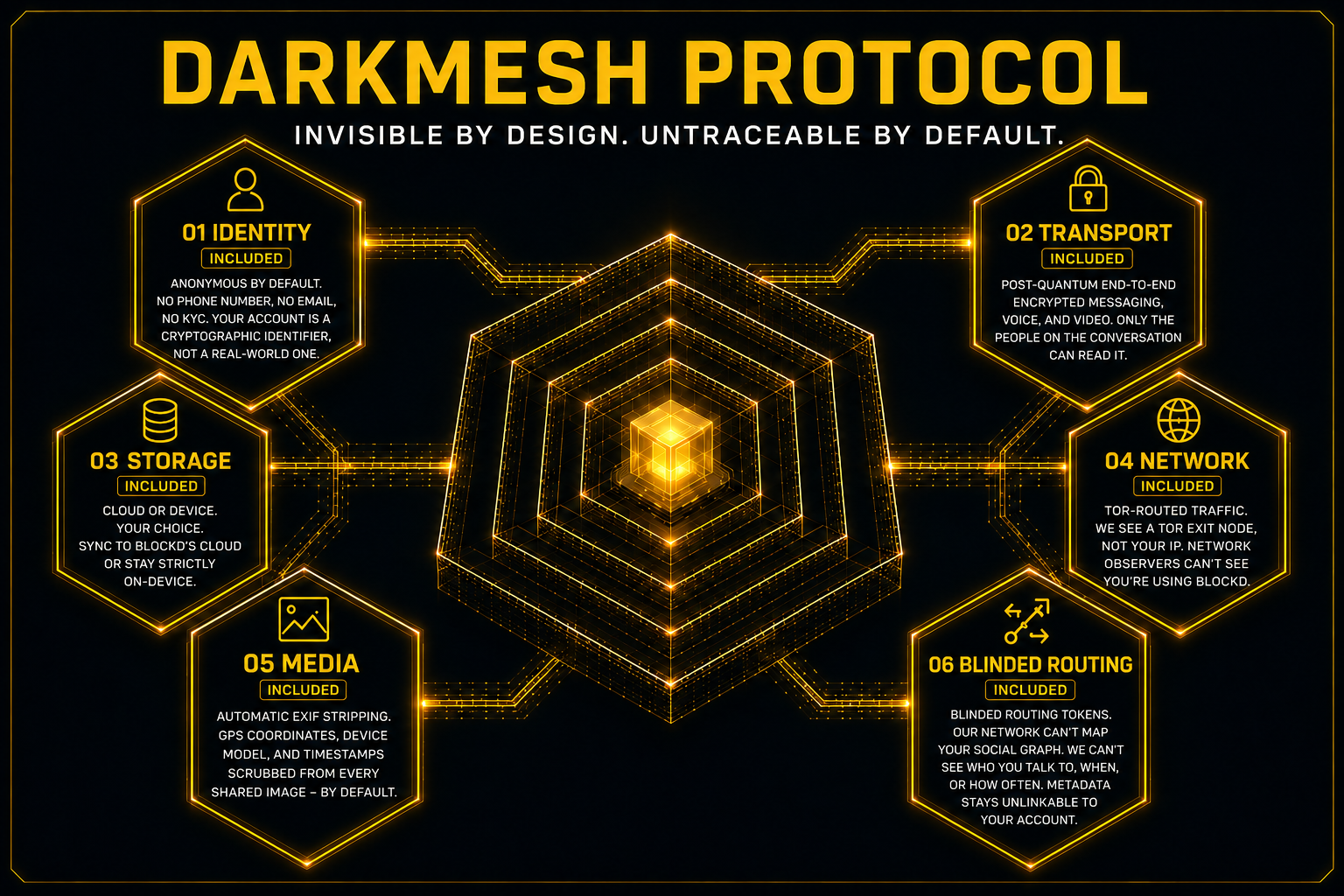
THE DARKMESH PROTOCOL

DarkMesh: The protocol that does what encryption alone can't.

Six layers of privacy discipline. Each closes a different attack surface.

DarkMesh Protocol diagram showing six layers of privacy: Identity, Transport, Storage, Network, Media, and Blinded Routing.

No single layer is a silver bullet. Together they make Blockd hard to subpoena, hard to breach, and harder to surveil than any centralized messenger.

Trust is not a privacy strategy.

Less to store. Less to leak. Less to subpoena.

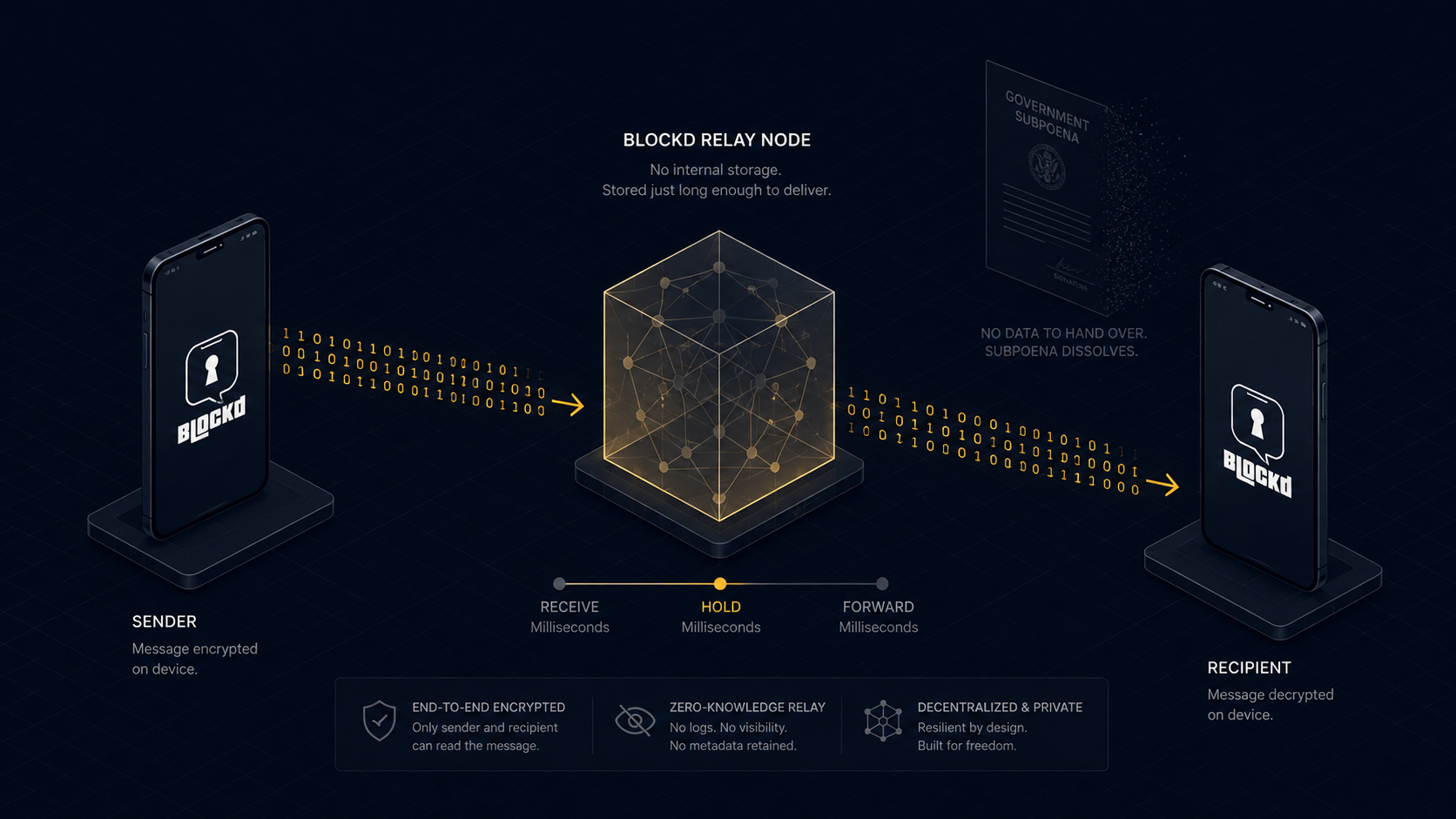
We hold them only long enough to deliver, then they're gone. No phone number required, and the architecture is designed not to retain message content or keys. There's little to subpoena because there's little we keep.

Nothing to breach because there's nothing to read.

Plaintext only exists on the devices in your conversation. Our servers see encrypted bits that are meaningless without your key. You choose where your messages live: your own device, or Blockd's cloud for sync.
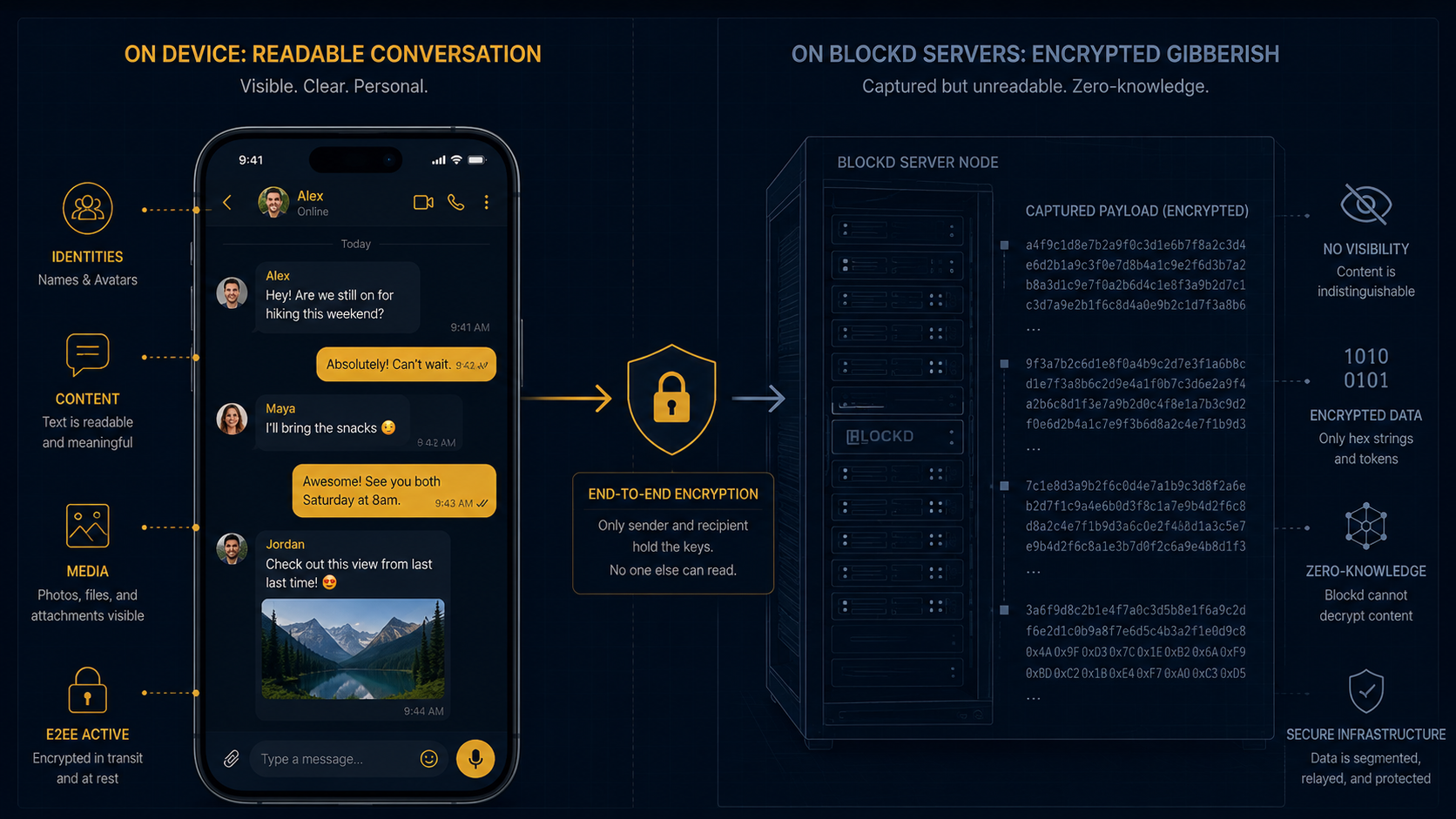
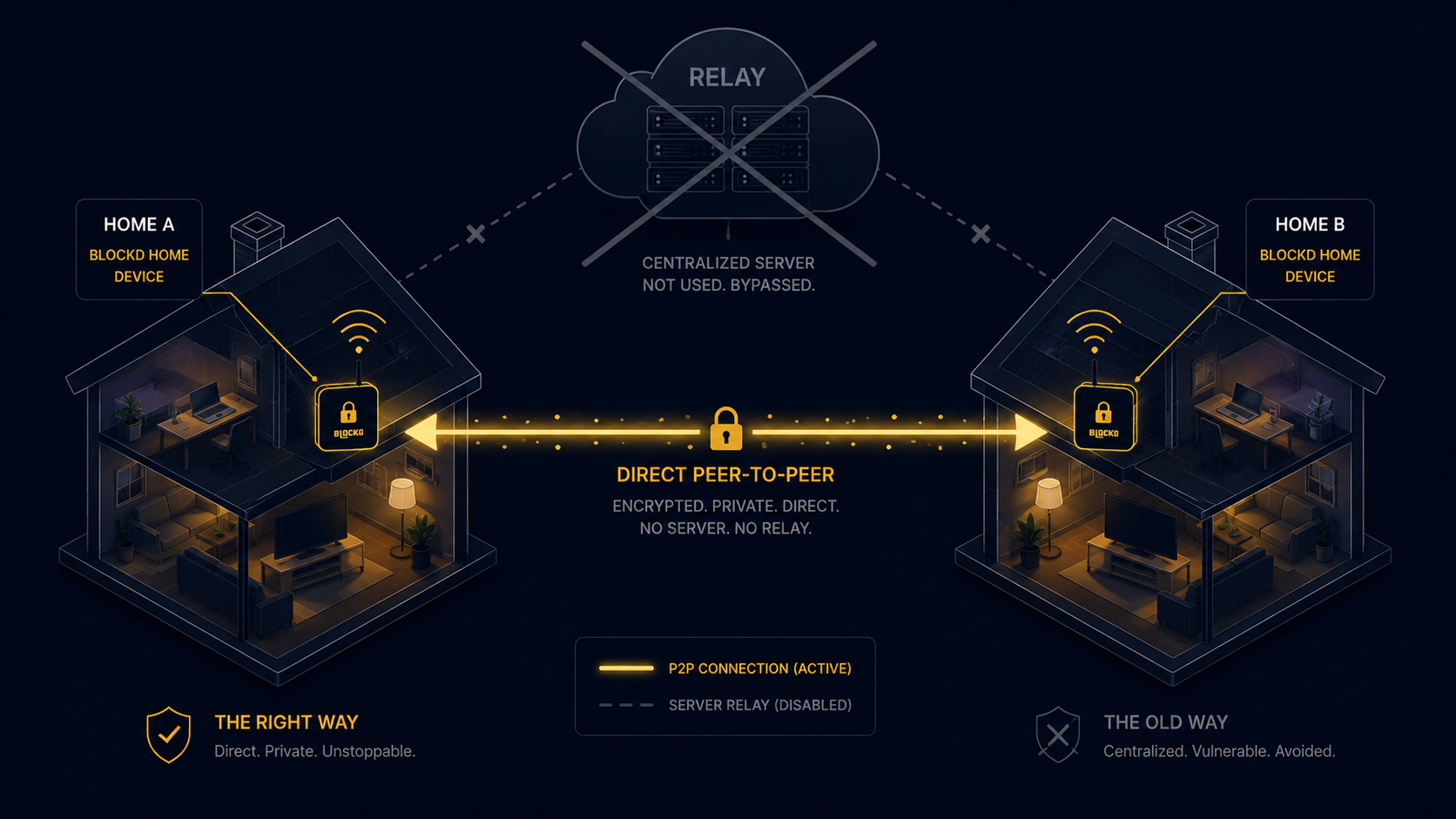
With Blockd Home, we're not even in the path.

Blockd Home routes peer-to-peer between you and your contacts directly — bypassing our relays entirely. The architecture, not the company, becomes the guarantee. Privacy stops being a promise and starts being a wire diagram.

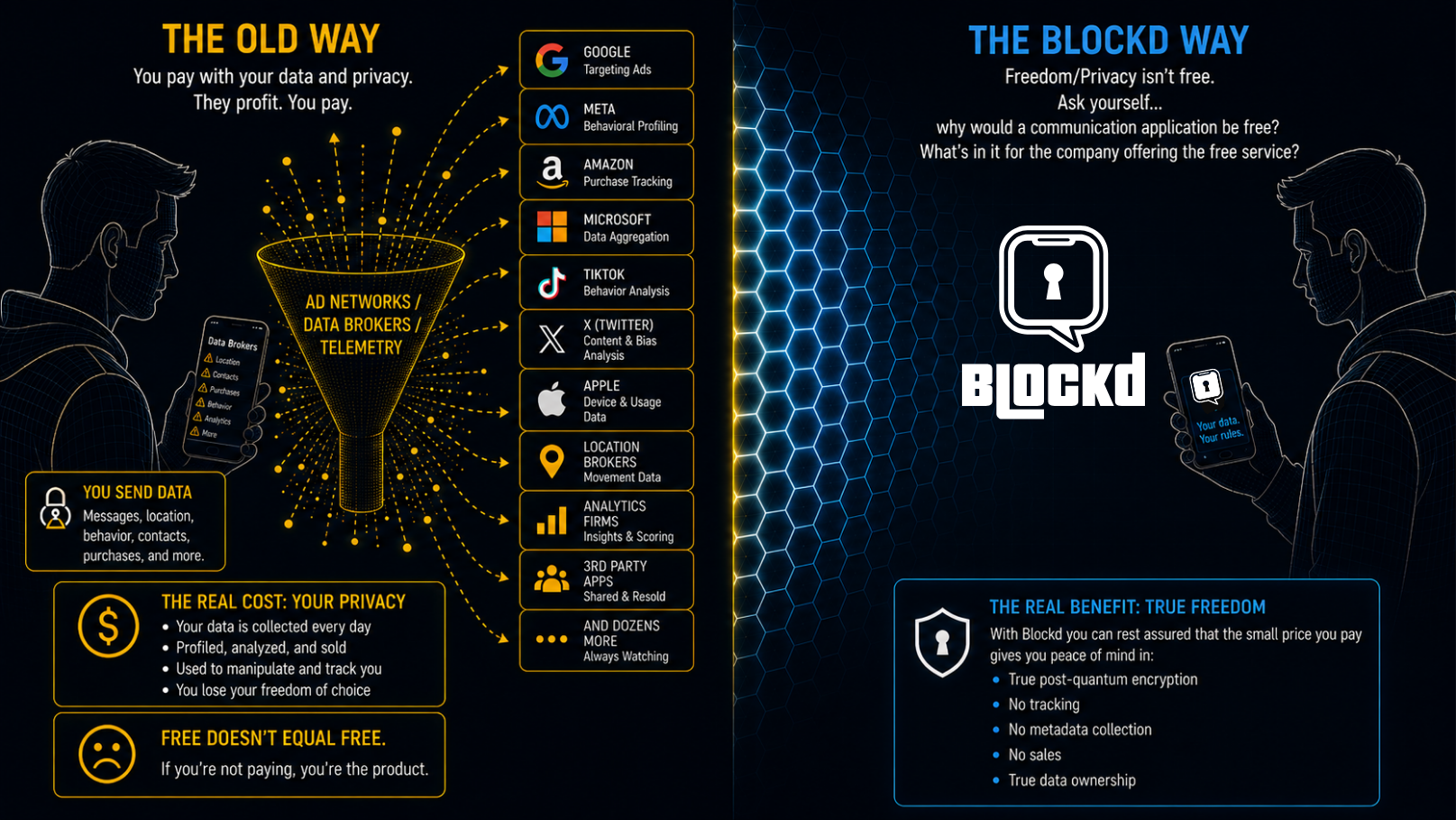
The funding model is the architecture.

The Old Way vs The Blockd Way — funding model comparison

If you're not paying for the product, your data is the product. We picked the other side of that trade. Paid by users. Not by ads, data brokers, or telemetry deals.

AN ECOSYSTEM, NOT AN APP

One company. One trust model. Your entire private stack.

Most privacy means stitching together five apps from five companies. Blockd is one stack. One company. One paid model. One trust model.

SHIPPING TODAY

End-to-end encrypted messaging

Voice & video calls

Anonymous signup — no phone number

Disappearing messages

Group chats

Blinded routing tokens

Tor routing — Premium

Automatic EXIF stripping — Premium

Larger file transfers — Premium

ROADMAP (2026–2028)

Blockd Home — trustless self-hosted hardware (Q4 2026)

Blockd Mail — encrypted email (2027)

Blockd Drive — encrypted file storage (2027)

Blockd Vault — password manager (2027)

Blockd Intelligence — on-device AI (2027–2028)

All bound by the same trustless architecture. All paid for the same way.

THE TRUSTLESS LADDER

How much do you have to trust us? You choose.

All features are currently free during early access. Premium subscription and Blockd Home device sales activate later — get the full experience while the on-ramp is open.

MODE 1 — FREE

Blockd App + our relays

End-to-end encrypted messaging and calls. Anonymous signup, no phone number. Blinded routing tokens so the network can't map your social graph. Same trust model as Signal — you take our word that we don't store your data.

$0 — free forever

Download iOS Beta

MODE 2 — PREMIUM

FREE NOW — $6/MO LATER

Premium + Tor + media hygiene

Native Tor routing, so we see a Tor exit node, not your IP. Automatic EXIF stripping on shared images. Larger file transfers. Higher-quality voice and video. Less trust required, far more privacy at the network layer.

Premium activates Q4 2026

Get Premium Free

MODE 3 — BLOCKD HOME

CROWD SUPPLY Q4 2026

Trustless by network topology

A device that sits in your house and runs your private messaging, files, and AI directly. Your phone routes everything through your hardware, not our cloud. Zero trust required — by network topology, not by promise.

From $649 — Reserve a unit

Reserve Blockd Home →

Mode 1 trusts us. Mode 2 trusts the architecture. Mode 3 doesn't have to trust anyone.

THE TRUSTLESS PRIVACY DEVICE — Q4 2026

Stop trusting. Start owning.

Blockd Home is a small, silent appliance that plugs into your router. It runs your private messaging, calls, files, email, passwords, and AI — on hardware you own, in a house no provider can subpoena.

Ships pre-flashed. Five-minute setup from the Blockd app. No Linux command line, no port forwarding, no PhD required. Designed for the kitchen counter, not the server rack.

Blockd Home privacy hub in cinematic key light

32 GB unified memory · 256 GB SSD

Hailo-8 NPU · 26 TOPS on-device AI

Fanless milled aluminum chassis

Get the iOS beta. Reserve the hardware.

Download Blockd today. Reserve a Blockd Home for Q4 2026. One email when each goes live — never a marketing drip.

WHO BUILT THIS

Built by founders who use it themselves.

Blockd is built by founders whose own privacy depends on it. We started this company because we couldn't find a privacy stack we actually trusted. Every “private” service we evaluated still required us to take someone's word for it. So we built the alternative — one company, one paid model, one trust model you can verify with a network analyzer.

Joshua Hartsel, Founder & CEO

Joshua Hartsel, PhD

Founder & CEO

I started Blockd because I couldn't find a privacy stack I actually trusted. Every “private” service I evaluated still required me to take someone's word for it. So I'm building the alternative — one company, one paid model, one trust model you can verify with a network analyzer.

PhD chemistry. Previously co-founder of Adelia Therapeutics (acquired by Cybin, NYSE).

Fazri Zubair, CTO & Co-founder

Fazri Zubair

CTO & Co-founder

I build systems that assume the infrastructure underneath is hostile. Blockd is that worldview applied to a privacy platform — every network the app touches is treated as the adversary, not the partner.

Distributed systems, container orchestration, consumer hardware.

A small, focused team. Building Blockd full-time since October 2024.

The State of Privacy.

State of Privacy

Your Metadata Is Giving You Away

You can encrypt every word you send and still hand over the story of your life. Metadata, who you talk to and when, is the part that gives you away, and it is collected by default.

State of Privacy

Encrypted Isn't Private: Why Encryption Alone Fails

End-to-end encryption protects what you say. It does nothing about who you talk to, when, and from where. Here is the difference between encryption and privacy, and why the gap is the whole game.

State of Privacy

DarkMesh, Explained: How Blockd Minimizes Metadata

Encryption hides what you say. It does nothing about who you talk to, when, and how often. DarkMesh is the six-layer architecture Blockd uses to leave less of that behind.

State of Privacy

Why we built Blockd Home

Trust is the unsolved layer of personal privacy. Encryption was step one. Hardware ownership is the endpoint. Why we built Blockd Home — and what it means for the next surveillance frontier.

State of Privacy

Blockd vs Signal: An Honest Comparison (2026)

Blockd and Signal both encrypt your messages. Only one is building a trustless privacy ecosystem you can verify, not just trust. An honest comparison from the team that builds Blockd — including where Signal wins.

State of Privacy

Zero Knowledge Password Managers: How To Protect Your Vault When Your Provider Gets Hacked

Only 36% of US adults use password managers, yet users who do are nearly half as likely to suffer credential theft compared to those who do not, which shows how critical these tools are when they are built on true zero knowledge architecture and paired with strong anonymity practices.

State of Privacy

Advanced Data Protection for iCloud and Android: How To Keep Apple and Google Away From Your Encryption Keys

Cloud data is a liability when someone else holds the keys, and with studies showing that on average 47% of data in the cloud is sensitive while fewer than 10% of enterprises encrypt 80% or more of it, relying on default settings from Apple or Google is not enough if you care about real privacy.

State of Privacy

The Growing List of Messaging App Data Breaches: Lessons Learned

In today’s digital landscape, messaging apps have become the backbone of our daily communications. From personal conversations to business collaboration, these platforms handle some of our most sensitive information. At the same time, the growing frequency of messaging-app breaches has raised serious concerns that go far beyond inconvenience—these incidents represent fundamental threats to personal safety, corporate security, and digital trust.

State of Privacy

Big Tech Surveillance: What WhatsApp, Telegram, and Signal Actually Know About You

Have you ever stopped to think about what happens to all those messages you send every day? In a world where we chat with friends, share personal photos, and even discuss sensitive information through messaging apps, the question of who can see this data has never been more important. Most of us use these apps without giving much thought to what’s happening behind the scenes, essentially trusting our digital conversations to corporations with varying commitments to privacy and data protection.

State of Privacy

Centralized vs Decentralized Privacy Infrastructures: Which Actually Keeps You Invisible?

Your data is not leaking in theory, it is leaking in practice. Identity fraud attacks rose 180% year over year, and 52% of people report being targeted by fraud attempts or breaches. In a world where centralized platforms log everything you do, from your phone number to your social graph, comparing centralized vs decentralized privacy infrastructures is no longer academic—it is the difference between being monitored and being invisible.

State of Privacy

Onion Routing Explained: How It Makes Communication Effectively Untraceable (And Why We Use It)

About 2.5 million people rely on the Tor network every day for onion routed traffic, yet most of their friends still believe that “end-to-end encryption” is enough. It is not. Encryption hides what you say, but without anonymity and onion routing, your metadata still exposes who you are talking to, when, how often, and from where. In a world built on surveillance, we need to analyze onion routing not as a niche trick, but as the backbone of truly untraceable communication.

State of Privacy

Why Privacy Isn't Paranoia-It's a Human Right in the Digital Age

When you close your bedroom curtains at night, are you being paranoid? When you seal an envelope before mailing it, is that excessive secrecy? When you close the bathroom door, are you hiding something sinister? Of course not. These are normal expressions of privacy—a fundamental human need that exists independently of whether you're doing anything wrong.

State of Privacy

Top Techniques for Ensuring Online Anonymity

In today's digital world, our personal information faces many risks. Data breaches happen often, surveillance systems are growing, and tracking technologies are getting better. Keeping your identity hidden online has become really important, not just nice to have. True privacy needs anonymity - being able to use online services without revealing who you really are.

State of Privacy

Top Features to Look for in Secure Messengers

Our conversations are more at risk than ever in today's digital world. Regular messaging apps often put cool features ahead of privacy, which can put your private information at risk. Secure messaging has become really important as privacy concerns grow worldwide, with more government surveillance, data breaches happening more often, and companies getting better at collecting and analyzing our data.

State of Privacy

How to Maximize Privacy Online in 2025

In today's connected world, our digital footprints are bigger than ever before. As we go through 2025, good privacy measures aren't just nice to have – they're necessary. Every day, companies, governments, and hackers collect, analyze, and make money from our personal data. Over 80% of people worry about how their personal data is used online. This worry makes sense because our online activities are being watched and used in ways most of us don't understand or agree to.

Join the Movement

Be one of the first to shape the future of private communication.
Download Blockd & Sign up below to get App Updates, Free Perks & Early Access to new versions of Blockd
(Android Coming Soon)

Thank you! Your submission has been received!
Oops! Something went wrong while submitting the form.