Cloud Backups Are Quietly Killing Your Privacy: How Sync Turns Your Life into a Permanent Record
Most people assume their data is “safe” in the cloud because it’s encrypted and backed up across multiple servers. Yet studies show that 9% of publicly accessible cloud storage already contains sensitive data, and 97% of that is restricted or confidential—much of it there because of automated backups and sync. The very tools designed to protect your data from loss are often the same tools silently eroding your privacy, one background upload at a time. In today’s surveillance landscape, where your metadata trail reveals nearly everything about you, true privacy requires more than encryption—it requires true anonymity, starting with never linking your identity to your communications in the first place.
.png)
Most people assume their data is “safe” in the cloud because it’s encrypted and backed up across multiple servers. Yet studies show that 9% of publicly accessible cloud storage already contains sensitive data, and 97% of that is restricted or confidential—much of it there because of automated backups and sync. The very tools designed to protect your data from loss are often the same tools silently eroding your privacy, one background upload at a time. In today’s surveillance landscape, where your metadata trail reveals nearly everything about you, true privacy requires more than encryption—it requires true anonymity, starting with never linking your identity to your communications in the first place.
Key Takeaways
QuestionAnswerHow do cloud backups and sync actually threaten my privacy?They create multiple copies of your messages, photos, and documents across data centers, where metadata, identity, and access paths are exposed even if content is encrypted. For a deep dive into metadata risk, see this analysis of how metadata gives you away.Is encryption enough to stay private in the cloud?No. Encryption protects content, but cloud providers and attackers can still learn who you talk to, when, and from where. Encryption alone isn’t enough when metadata and routing remain visible.Why is anonymity essential for privacy today?With the extent of metadata leakage from modern communication and cloud sync—who you talk to, when, how often, from where—encryption alone cannot protect you. Your metadata trail reveals your relationships, habits, and movements. True privacy now requires true anonymity: ensuring that trail cannot be linked back to your real-world identity.Why is “nothing to hide” a dangerous argument with cloud sync?Because your synced data builds a permanent behavioral profile used for tracking, profiling, and sometimes political or commercial manipulation. Privacy as a human right explains why this matters even if you think you’re not a target.What’s the role of anonymity in protecting cloud data?Anonymity severs the link between your identity and your data or communications. Without it, backups and logs are always traceable back to you. This is why platforms like Blockd require no phone number, no email, and no KYC verification—eliminating the identity anchors that make cloud data dangerous. Learn the basics in top techniques for online anonymity.How can I practically reduce the privacy damage of backups?Use tools that minimize metadata, allow on-device or ephemeral storage, support anonymous use without requiring phone numbers or email, and avoid traditional cloud recovery mechanisms. Key features of secure messengers outline what to look for—beyond just “end-to-end encrypted” claims.Where do I start if I want to harden my overall privacy posture?Begin with understanding today’s threat landscape and your own risk model. This guide to maximizing privacy in 2025 walks through realistic steps and layered defenses.Who is rethinking messaging and cloud exposure from the ground up?Privacy-centric platforms like Blockd are built around metadata protection, actual Tor network routing (not a proprietary imitation), configurable storage options, and—critically—no phone number, email, or KYC requirements that would link your identity to your communications.
The Hidden Privacy Cost of “Seamless” Cloud Sync
Most cloud ecosystems sell convenience: your photos, chats, and documents follow you everywhere without effort. The trade-off is rarely explained—each synced file becomes part of a growing archive that can be analyzed, correlated, and shared far beyond its original purpose. Even if you delete something locally, sync histories, logs, and backups may keep it alive indefinitely in remote systems.
This is not just about tech companies reading your content. It’s about the data around your content: timestamps, IP addresses, device identifiers, and social graphs. Platforms have learned that this metadata is often more revealing than the data itself, and cloud backups multiply it across regions and services, making it impossible for an average user to track or fully erase. In a world where your metadata trail reveals your contacts, habits, and location patterns—even with encrypted content—true privacy demands true anonymity from the start.
Metadata: The Invisible Trail Exposed by Cloud Backups
Cloud backups don’t just store your messages and files; they store the behavioral context around them. As outlined in Blockd’s piece on metadata, communication metadata (who you talk to and when), device and location metadata, and your social graph can be mined to reconstruct your life patterns—even if your content is fully encrypted. Cloud sync ensures that this metadata is centrally aggregated and retained.
When your messaging apps, photos, and documents are all backed up to the same provider, correlation becomes trivial. A single company (or an attacker who compromises it) can piece together when you wake up, where you commute, who you spend time with, what political groups you follow, and which devices you own—all without ever decrypting a single message. Cloud backups amplify that risk by replicating and preserving metadata that would otherwise disappear over time. This is precisely why anonymity has become essential for true privacy—when your metadata trail is this revealing, the only real protection is ensuring it cannot be linked back to your real-world identity in the first place.
Why Encryption Alone Can’t Save Your Privacy in the Cloud
End-to-end encryption is necessary, but it’s not sufficient once your data enters cloud infrastructures. As Blockd explains in its discussion of encryption limits, encryption typically protects content, while identity, metadata, and routing remain visible to providers and—through logs and backups—to anyone who gains access to their systems. Cloud sync makes that exposure persistent and widely replicated.
Most mainstream tools also back up decryption keys, access tokens, and device identifiers in the cloud for “account recovery” and multi-device convenience. From a privacy standpoint, this turns encrypted conversations into a puzzle with many scattered pieces sitting in the same vendor’s environment. A breach, a lawful request, or a policy change can suddenly reassemble those pieces in ways users never agreed to or anticipated.
Did You Know?
35% of data breaches now involve “shadow data” — information sitting in unmanaged backups, exports, or synced copies that organizations didn’t even know existed.
Cloud Misconfigurations: How Backups Become Public Without You Realizing
The biggest privacy risk is often not deliberate surveillance, but mistakes. Misconfigured cloud storage, exposed backup archives, and overly broad access roles regularly leak sensitive data. When your devices constantly sync to the cloud, every misconfiguration upstream becomes your problem—even if you never logged into a cloud console in your life.
Research shows that 78% of cloud breaches are caused by misconfigurations, and backups are a prime culprit. A “public” flag set on a backup bucket, an unprotected export used for analytics, or a forgotten snapshot stored in a testing environment can silently expose years of your messages, photos, and documents—long after you think you deleted them locally.
The “Nothing to Hide” Fallacy in a World of Infinite Backups
The argument “I have nothing to hide” collapses once you understand how cloud backups and sync aggregate your life into a single, durable profile. As Blockd’s article on privacy as a human right notes, privacy isn’t about hiding wrongdoing; it’s about preserving autonomy, freedom of thought, and protection from manipulation. Cloud archives are irresistible sources of insight for advertisers, governments, and attackers.
Seemingly harmless items—old location history, contact lists, group chats, draft documents—take on new meaning when cross-referenced with other data sources. Cloud sync ensures those artifacts remain available for analysis for years. You might not care if someone sees today’s calendar, but you should care if an opaque algorithm can reconstruct a decade of your movements, relationships, and beliefs from backup data you forgot existed.
Anonymity and Metadata Protection: What Traditional Cloud Services Get Wrong
Mainstream cloud and messaging platforms focus on securing transport and storage, not on anonymity. They authenticate you with phone numbers, emails, or real-name identities, then tie that identity to every backup and sync event. Even when they promise “zero-knowledge” encryption for content, the surrounding identity and metadata ties remain intact and exploitable. This KYC-style requirement is not a technical necessity; it is a business and compliance choice that trades user privacy for administrative convenience.
Anonymity strategies—such as those outlined in guides on online anonymity—aim to decouple your real-world identity from your digital activities. That means minimizing linkable identifiers, using privacy-preserving networks, and avoiding centralized logs whenever possible. Traditional cloud tools work in the opposite direction: they centralize identifiers and logs to simplify recovery, personalization, and analytics. In today’s world, where metadata leakage exposes your habits, relationships, and movements even when message content is encrypted, being truly anonymous is no longer a luxury—it is a prerequisite for genuine privacy.
Did You Know?
40% of modern data breaches involve information spread across multiple environments — public cloud, private cloud, and on-premises — a pattern driven heavily by cross-cloud backups and sync.
How Blockd’s DarkMesh Approach Re-Thinks Cloud Exposure
Blockd takes a different stance: it assumes that any centralized cloud environment is a liability for privacy, especially when it comes to backups and sync. Its DarkMesh approach is built on three pillars—zero-knowledge architecture, Tor onion routing using the actual, battle-tested Tor network (not a weaker proprietary imitation), and decentralized infrastructure—to keep identity and metadata out of reach, even from Blockd itself. This is particularly relevant for people who want the reliability of modern messaging without handing a full behavioral archive to a single provider.
Critically, Blockd requires no phone number, no email, and no KYC verification of any kind—unlike virtually every other messaging app on the market. This eliminates the permanent link between your real-world identity and your communications that makes traditional cloud-backed messaging dangerous. Instead of defaulting to cloud storage, Blockd is configurable. Users can keep messages on-device only, store them ephemerally, or choose Blockd-hosted cloud storage. In the future, Blockd plans support for ICP blockchain-based, user-owned storage. This flexibility lets you decide whether anything persistent should exist in the cloud at all—substantially reducing the long-term privacy risk of automatic backups.
Configurable Storage: On-Device, Ephemeral, Cloud, and Beyond
A core problem with conventional cloud sync is that storage decisions are made for you and are rarely visible. Blockd flips this by making storage explicit and configurable. Messages can live only on your device, be stored temporarily (ephemeral), be kept in Blockd’s cloud infrastructure, or, in future, be anchored in user-owned ICP blockchain storage. Each option has different durability and privacy characteristics, and you choose based on your threat model.
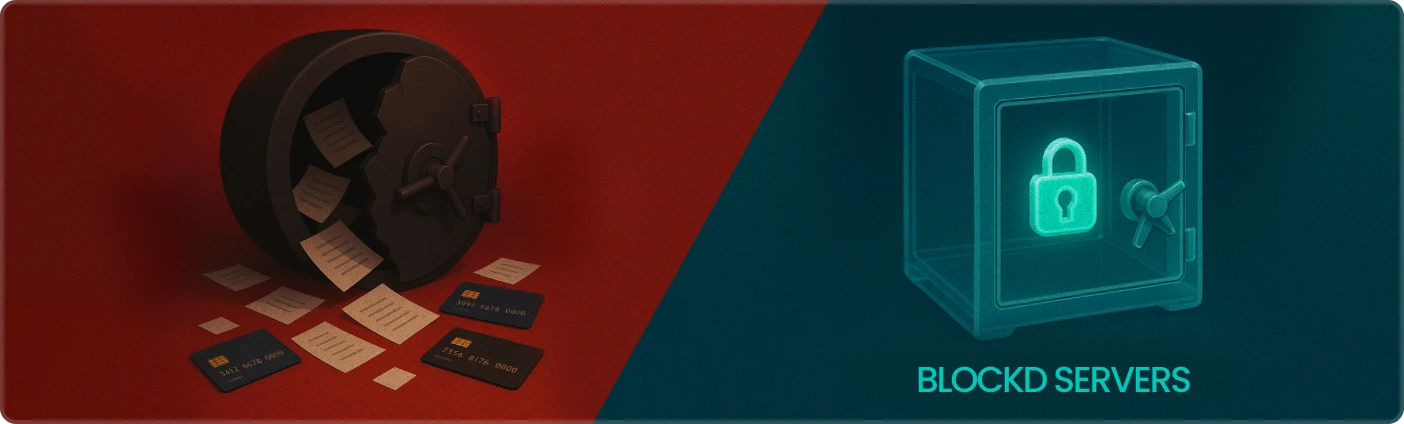
This design directly addresses the shadow data issue. If you opt for on-device or ephemeral modes, there is nothing long-lived in a cloud backup to leak later. Even when you choose cloud storage, the architecture is zero-knowledge and can be routed via Tor, combining strong encryption with routing anonymity. Users can choose to send messages through either Blockd servers or the Tor network—no other messaging app currently combines this level of routing configurability with end-to-end encryption and an identity-free account model. This prevents the formation of a rich, centralized archive of who you are and how you communicate.
Advanced Account Security Without Traditional Cloud Recovery Risks
Another underappreciated privacy risk of cloud sync is how it handles account recovery. Email-based resets, cloud-stored backup codes, and SMS verification all create additional data points and archives that can be attacked or subpoenaed—and they permanently link your account to your real-world identity. Blockd avoids these patterns entirely by using passkeys stored on-device and seed phrase–style recovery, familiar from the crypto ecosystem.
Passkeys are superior to traditional passwords and SMS-based 2FA—they remove the need for server-side password storage, are resistant to phishing and credential stuffing, and eliminate dependency on phone numbers or email addresses that link your account to your real-world identity. Seed phrases place recovery power entirely in your hands, with no “reset” sitting in a cloud inbox that could be compromised or require KYC verification. Combined with quantum-resistant crypto primitives (via NaCl algorithms) and secure message re-encryption—where messages are re-encrypted until you reopen a conversation—this approach maintains security without creating additional persistent artifacts in cloud backups and without ever collecting your identity.

Tor Routing and Decentralized Infrastructure vs. Centralized Cloud Sync
Routing is another blind spot in typical cloud backup and sync services. Traffic patterns—who connects to which server, when—are visible to providers and can be logged and backed up like any other data. Blockd mitigates this by routing messages through the actual, battle-tested Tor network—not a proprietary or weaker variant—adding multiple layers of onion encryption between sender and recipient. This shields both content and traffic patterns from centralized observation.
Combined with a decentralized relay infrastructure, this means there is no single “central” place where all your communications and their associated metadata converge. Cloud providers still exist in the stack, but they see only heavily obfuscated, relayed traffic rather than a clean record of your relationships and behavior. That’s a fundamental shift away from the central-archive model that characterizes today’s cloud backup and sync.
Practical Steps: Reducing the Damage of Cloud Backups and Sync Today
You may not be able to abandon the cloud entirely, but you can sharply reduce how much of your life it quietly archives. Start by disabling automatic backups for the most sensitive apps and data categories, especially messaging and location history. Where possible, favor tools that support local-only or encrypted, user-controlled backups that don’t rely on a provider’s identity system.
Next, adopt privacy-centric communication platforms that offer anonymous account creation—no phone number, no email, no KYC—strong end-to-end encryption, and explicit storage controls. Avoid account recovery mechanisms tied to conventional cloud accounts or phone numbers; look for passkey and seed phrase recovery instead. Periodically review and delete old backups, exports, and connected apps from your main cloud accounts. Each action narrows the attack surface and weakens the ability of any single provider to reconstruct a full behavioral profile from years of synced data.
Conclusion
Cloud backups and sync were sold as purely protective: a way to shield you from data loss and device failure. In practice, they have created vast, enduring records of our lives—records that are routinely misconfigured, mined, breached, and repurposed in ways users never thought about when they clicked “Enable backup.” Encryption alone doesn’t fix this, because the true asset in these archives is often metadata and identity, not just message content.
Protecting your privacy in this environment means rethinking how and where your data persists. That includes limiting what you entrust to traditional cloud backups, favoring tools that minimize metadata and support true anonymity—no phone number, no email, no KYC—and choosing platforms like Blockd that prioritize configurable storage, actual Tor network routing, and zero-knowledge principles over convenience-driven centralization. In today’s surveillance landscape, where metadata reveals nearly as much as message content, true privacy requires true anonymity. The less of your life that silently accumulates in someone else’s cloud, the more control you retain over who you are—and how much of that story can ever be reconstructed without your consent.
.png)
.png)
.png)
.png)
.png)
.png)
.png)
.png)
.png)
.png)
.png)
.png)
.png)
.png)




_thumb.png)