Why Privacy Isn't Paranoia-It's a Human Right in the Digital Age
When you close your bedroom curtains at night, are you being paranoid? When you seal an envelope before mailing it, is that excessive secrecy? When you close the bathroom door, are you hiding something sinister? Of course not. These are normal expressions of privacy—a fundamental human need that exists independently of whether you're doing anything wrong.
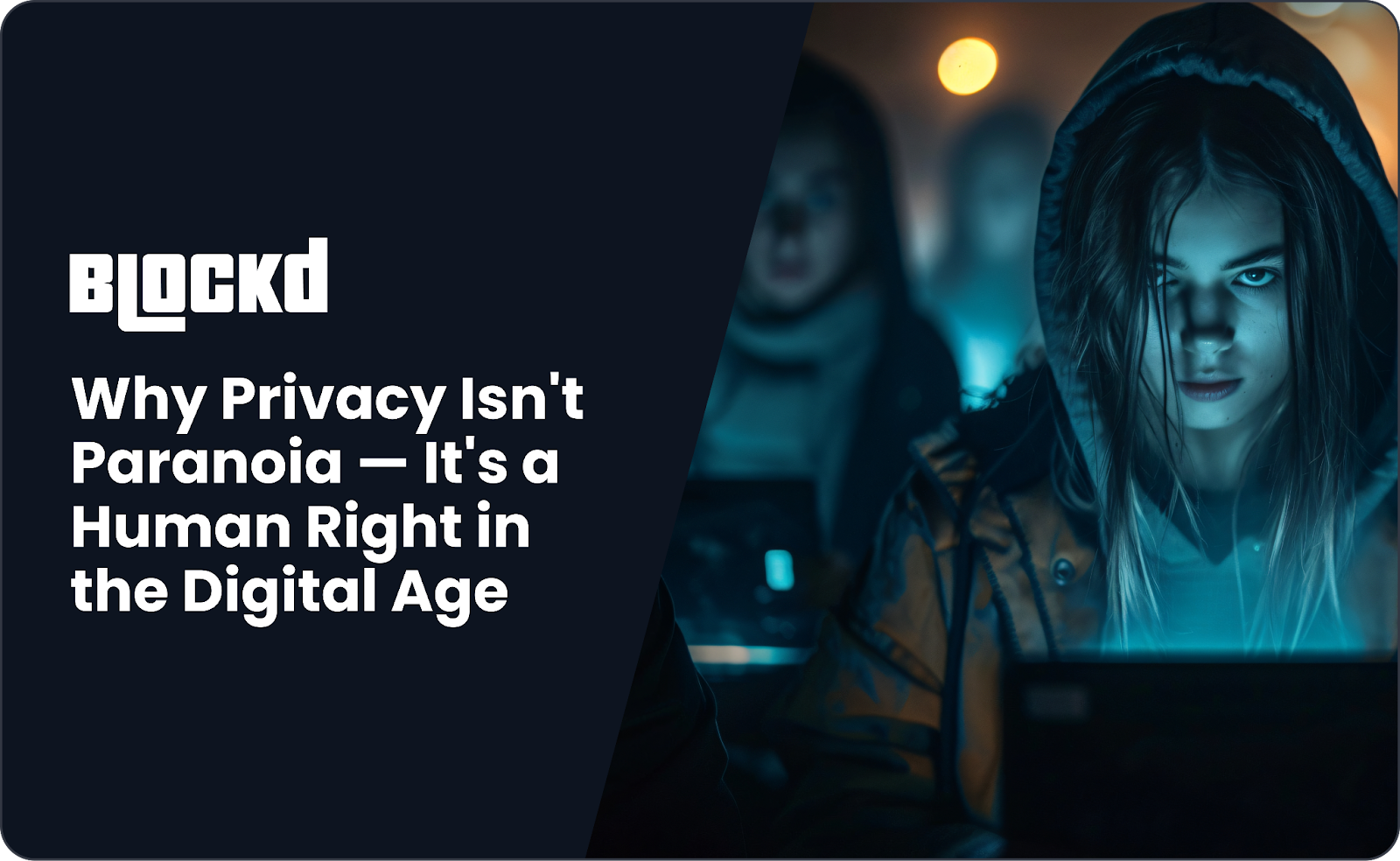
When you close your bedroom curtains at night, are you being paranoid? When you seal an envelope before mailing it, is that excessive secrecy? When you close the bathroom door, are you hiding something sinister? Of course not. These are normal expressions of privacy — a fundamental human need that exists independently of whether you're doing anything wrong.
Yet somehow, when it comes to digital privacy, we're expected to accept a different standard. Wanting privacy online is treated as suspicious. People who use encrypted messaging are viewed with skepticism. Individuals who refuse to hand over their personal data are seen as difficult or paranoid. This double standard isn't accidental — it's the result of decades of conditioning by corporations and governments that profit from surveillance.
The Birth of Surveillance Capitalism
To understand why privacy matters, we need to understand what we're up against. In 2019, Harvard Business School professor Shoshana Zuboff published The Age of Surveillance Capitalism, documenting how our digital lives became commodities traded for profit.
Here’s how it works:
Companies like Google and Facebook discovered they could extract far more value from users than simple advertising revenue. By tracking every click, every search, every interaction, they could build psychological profiles detailed enough to predict — and influence — future behavior.
This isn't traditional capitalism where companies make products and sell them to customers. This is a fundamentally different economic model where human experience itself is the raw material, extracted without meaningful consent, refined into predictions about your future behavior, and sold to anyone willing to pay.
The Four Pillars of Surveillance Capitalism
Zuboff identifies four key features that define this new economic order:
- Relentless Data Extraction
Every action you take online generates data. Every website you visit. Every product you view. Every person you message. This data is extracted continuously, comprehensively, and often without your awareness. - Behavioral Surplus
Companies collect far more data than necessary to provide their services. This “surplus” becomes the raw material for prediction products sold to third parties — advertisers, insurers, employers, political campaigns. - Prediction Algorithms
Machine learning systems analyze your behavioral data to predict what you'll do next. Not just what you might buy, but how you'll vote, whether you'll default on a loan, if you're likely to get sick, even whether you might commit a crime. - Behavioral Modification
The endgame isn't just predicting your behavior — it's shaping it. Platforms are designed to guide you toward outcomes that maximize corporate profits, whether that's keeping you engaged, making you angry, or getting you to buy things you don't need.
This system doesn’t exist in a few rogue apps — it’s the foundational business model of the modern internet. And it's fundamentally incompatible with human autonomy and dignity.
Privacy as a Legal Human Right
Privacy isn't just a nice idea — it's codified in international law as a fundamental human right.
Article 12 of the Universal Declaration of Human Rights (UDHR), adopted by the United Nations in 1948, states:
“No one shall be subjected to arbitrary interference with his privacy, family, home or correspondence, nor to attacks upon his honour and reputation.
Everyone has the right to the protection of the law against such interference or attacks.”
This right is reinforced in:
- The International Covenant on Civil and Political Rights (Article 17)
- The European Convention on Human Rights (Article 8)
- The American Convention on Human Rights (Article 11)
- The African Charter on Human and Peoples' Rights (Article 4)
Why did the international community, fresh from World War II and facing the early Cold War, prioritize privacy as a universal human right?
Because the framers understood something crucial: privacy is not an end in itself, but the foundation upon which other rights depend.
Privacy Protects Democracy
Without privacy, there can be no meaningful democracy.
Citizens need the freedom to:
- inform themselves
- discuss ideas
- organize politically
- vote according to their conscience
…all without fear of surveillance or retaliation.
When every search you make is recorded, when every conversation is monitored, when your political leanings are profiled and exploited, you don't have genuine political freedom. You have the illusion of choice within a system designed to manipulate your decisions.
The Cambridge Analytica scandal demonstrated this danger concretely. By harvesting data from millions of Facebook users, the firm built psychological profiles used to target individuals with personalized political propaganda designed to exploit their fears and biases.
This wasn't advertising — it was behavioral engineering applied to democratic elections.
Privacy Protects Freedom of Thought
Before you can speak freely, you must think freely. And thinking requires a private space — mental and physical — where ideas can be explored without judgment or consequence.
When your every search is recorded and analyzed, you self-censor. You stop researching topics that might be misunderstood. You avoid controversial ideas not because you agree or disagree, but because you fear how others might interpret your curiosity. This chilling effect on intellectual freedom is real and measurable.
Studies show that awareness of surveillance changes behavior:
- People search for less controversial health information
- They avoid politically sensitive topics
- They conform to perceived norms rather than exploring independently
This is thought control through panopticon: the constant possibility of being watched creates compliance even when no one is actively watching.
Privacy Protects Vulnerable Populations
For marginalized communities, privacy isn't just important — it's essential for survival:
- Activists organizing for civil rights
- Whistleblowers exposing corruption
- Journalists protecting sources
- Domestic abuse survivors escaping dangerous situations
- LGBTQ+ individuals in hostile environments
- Political dissidents in authoritarian states
When we say “I have nothing to hide,” we’re usually speaking from a position of privilege. We’re assuming the current power structure will always work in our favor. We’re forgetting that laws change, governments change, and today’s acceptable behavior can become tomorrow’s persecution.
Historical Context:
In the 1950s, being gay was illegal in most of the United States.
In the 1960s, civil rights activists were surveilled by the FBI.
In the 1970s, anti-war protesters were targeted by the government.
In each case, people who “had nothing to hide” by today’s standards faced serious consequences because the law — and society — viewed them as threats.
The Real Costs of Surveillance
Beyond abstract principles, surveillance capitalism creates concrete harms that affect real people every day.
Discriminatory Decision-Making
Algorithms trained on biased data perpetuate and amplify discrimination.
People are denied:
- jobs
- housing
- loans
- insurance
based on proxies for race, class, and other protected characteristics. These decisions are made inside black boxes — you don’t know:
- why you were rejected
- what data was used
- how to appeal
A 2016 ProPublica investigation found that criminal risk assessment algorithms were racially biased, rating Black defendants as higher risk than white defendants with identical criminal histories. These algorithms influence:
- bail
- sentencing
- parole decisions
…affecting people’s freedom based on flawed predictions.
Economic Manipulation
Dynamic pricing algorithms charge different people different prices for the same product based on their predicted willingness to pay.
This isn’t market efficiency — it’s automated price discrimination that extracts maximum value from each customer.
Airlines, hotels, and e-commerce platforms routinely adjust prices based on:
- your browsing history
- device type
- location
- purchase history
Wealthier customers pay more. Desperate customers (e.g., booking last-minute) pay more. The system is designed to identify and exploit vulnerability.
Mental Health and Well-Being
Social media platforms use behavioral psychology to maximize engagement — which often means maximizing:
- anxiety
- outrage
- addiction
These platforms aren’t neutral tools; they’re designed to hack your brain’s reward systems and keep you scrolling.
Research links heavy social media use to:
- higher rates of depression
- anxiety
- loneliness
— especially among teenagers. The surveillance-driven engagement model isn’t a bug — it’s the business model. Your attention is the product, and platforms will use any psychological trick necessary to capture it.
Why Anonymous Communication Matters
This is where Blockd offers a fundamentally different approach.
While mainstream platforms require phone numbers — immediately connecting your identity to your digital life — Blockd operates on a principle of anonymity by design.
- No phone number
- No email address
- No identity verification linking you to your communications
This isn't a privacy setting you can toggle — it’s the architectural foundation of how the platform works.
Why does this matter?
Because you cannot have a metadata profile if there’s no identity to attach it to.
- You cannot be targeted by behavioral predictions if there’s no behavioral history tied to you.
- You cannot be manipulated by algorithms if there is no “you” in the system to profile.
The Difference Between Privacy and Anonymity
Many messaging apps offer encryption — Signal, WhatsApp, Telegram all scramble your message content. But:
Encryption alone is insufficient because it doesn’t protect your identity or your metadata.
Even with end-to-end encryption, these platforms still know:
- who you are (via phone number or account identity)
- who you talk to
- when you talk
- how often
- from where
…and can infer what you’re talking about from patterns.
This metadata is incredibly valuable — in many cases, more revealing than content.
Anonymity changes the equation entirely.
When Blockd can’t identify you, all that metadata becomes useless noise. There’s:
- no profile to build
- no behavior to predict
- no identity to exploit
The Technology of True Privacy
Blockd’s DarkMesh Protocol implements privacy through architecture, not marketing promises. Three core technologies work together:
1. Zero-Knowledge Architecture
Every:
- message
- identity element
- metadata fragment
is encrypted using zero-knowledge principles.
This means Blockd literally cannot:
- read your messages
- identify you
—even if:
- compelled by court order
- infiltrated by attackers
It’s not about corporate policy; it’s about math.
2. Tor Network Routing
Messages are routed through the actual Tor network — the same infrastructure used by:
- journalists
- activists
- security professionals
Your communications bounce through multiple anonymous relays:
- No single node knows both who sent and who received.
- IP addresses and locations are obscured by design.
This is battle-tested technology protecting some of the most sensitive communications on the planet.
3. Decentralized Infrastructure
There is:
- no central server to hack
- no master database to subpoena
- no single company that “owns” your data
DarkMesh distributes message relays globally, making:
- mass surveillance architecturally impossible
- shutdowns and centralized attacks far less effective
Reclaiming Your Rights
Privacy isn't dead — but it won’t return through:
- minor policy updates
- revised terms of service
- PR campaigns around “transparency”
It requires rebuilding digital infrastructure around human rights rather than corporate profits.
The good news? That infrastructure already exists.
Blockd demonstrates that privacy and functionality are not mutually exclusive:
- You can have secure messaging without surrendering your identity.
- You can have anonymous communication without sacrificing usability.
The Choice Is Clear:
Continue using platforms built on surveillance capitalism — where your identity, behavior, and relationships are the product being sold.
Or choose platforms built on privacy by design — where your communications belong to you, and only you.
Conclusion
Privacy isn’t paranoia — it’s a fundamental human right, recognized in international law precisely because it is foundational to:
- dignity
- autonomy
- freedom
The framers of the Universal Declaration of Human Rights understood this in 1948. We need to remember it in 2025.
The surveillance capitalism model is not inevitable. It’s:
- a choice made by corporations prioritizing profit over human rights
- enabled by governments prioritizing control over liberty
- tolerated by users who were rarely offered meaningful alternatives
But alternatives do exist.
Blockd proves that technology can serve human dignity instead of corporate surveillance:
- Zero-knowledge architecture
- Anonymous communication
- Tor network routing
- Decentralized infrastructure
These aren’t theoretical ideas — they are working systems protecting real people right now.
The question isn’t:
“Is privacy still possible in the digital age?”
It is.
The real questions are:
- Will we demand it?
- Will we choose platforms that actually protect it instead of just promising to?
Privacy is a human right.
Anonymity is essential to privacy.
And in 2025, the tools to protect both already exist.
The only thing standing between you and genuine digital privacy is the decision to use them.
.png)
.png)
.png)
.png)
.png)
.png)
.png)
.png)
.png)
.png)
.png)
.png)
.png)
.png)
.png)




_thumb.png)